A plan for the tabletop ecosystem we're building: open-source games, modular engines, and a marketplace for the modders who'll fill it.
Every rulebook is forkable. Every component is replaceable. Every variant is a pull request waiting to happen. Modders aren't a side channel — they're how the catalogue grows.
Not a publisher. Not a platform. A toolkit — modular game engines, a print-on-demand pipeline, and a marketplace — that turns the boards on your shelf into the boards you wanted them to be.
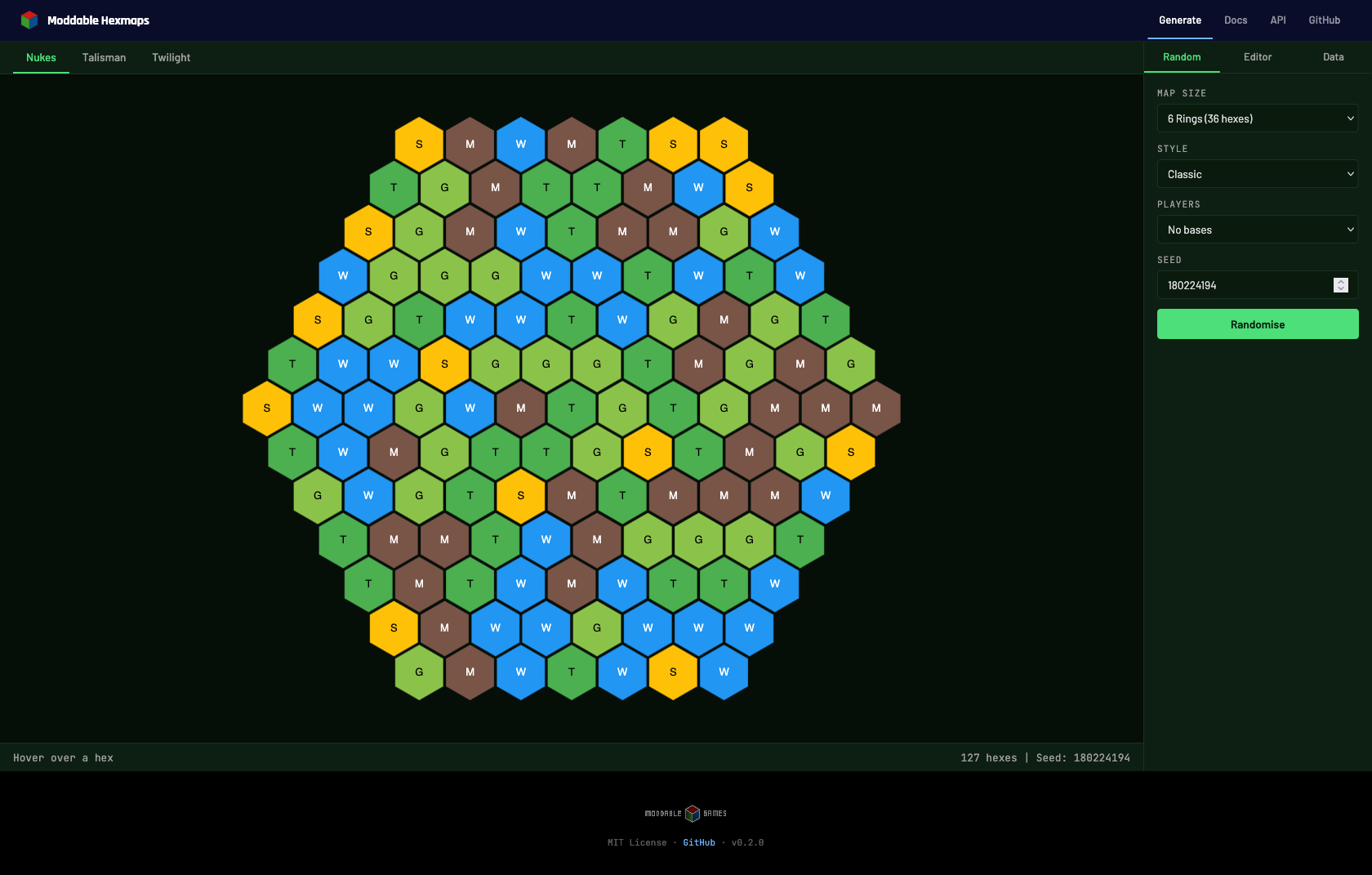
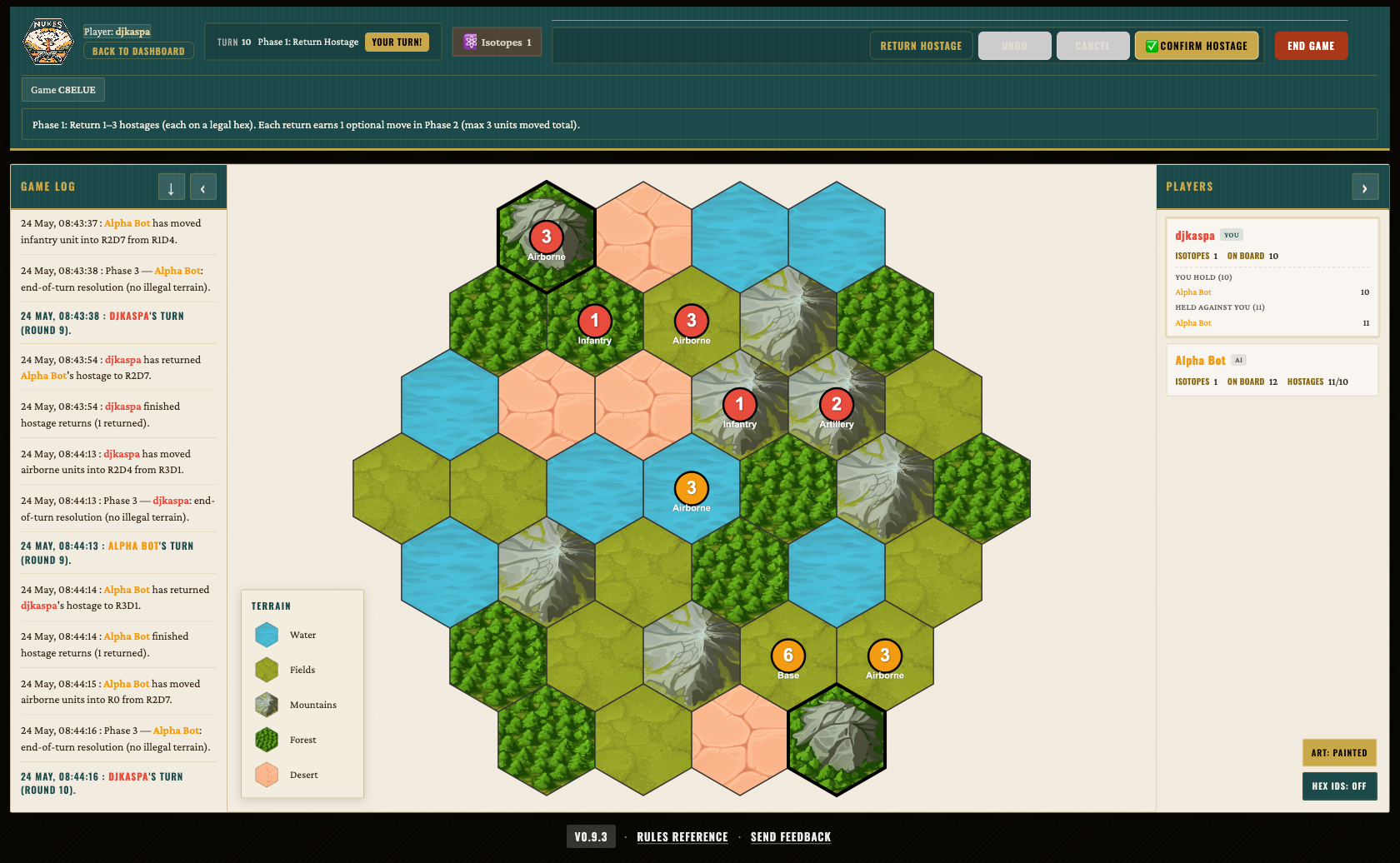
A hex-tile board game where every token is a unit, a hostage, and a countdown timer — all at once. Plays on a board you already own.
Nukes uses standard hex tiles — same size as Catan. 45 million homes already own half the board.
The north star: a structured rulebook becomes a playable game automatically. AI agents research and write. A universal engine renders. The catalogue grows itself.
Every one of them a hex board for Nukes — no new components required.
500M people have played. Econopoly ships a fairer rulebook.
Public-domain. Never been more popular. No moddable compendium yet.
The oldest installed base on the planet. Still played daily worldwide.
Reference · Cyberpunk TCG Kickstarter — US$25M raised · ign.com/articles/cyberpunk-tcg-kickstarter-record-25-million
One universal engine ships as an MCP server. Any AI agent can start a game, query rules, roll an oracle, or render a board on our infrastructure with a single command.
The merge is done. One universal kernel where every game is a config file and no variant carries code of its own. 10 families, 204 playable variants, 6,527 tests. One platform.
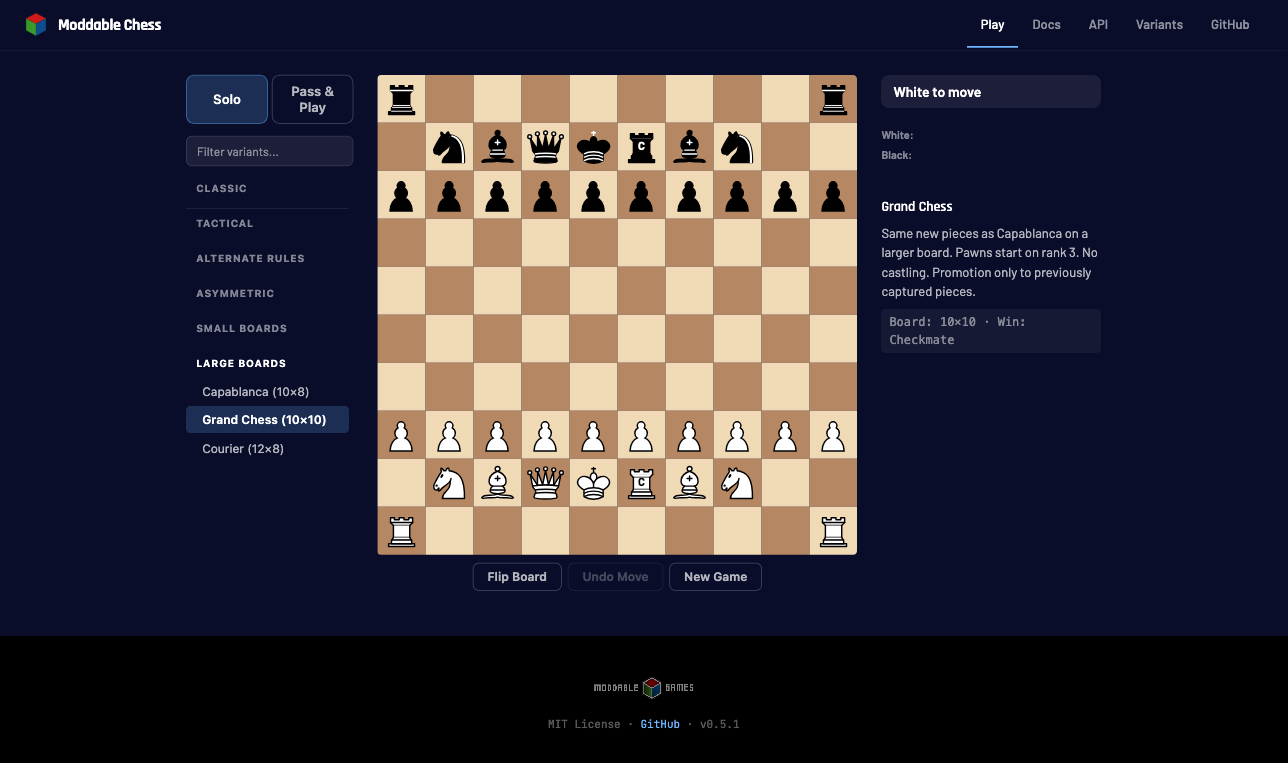
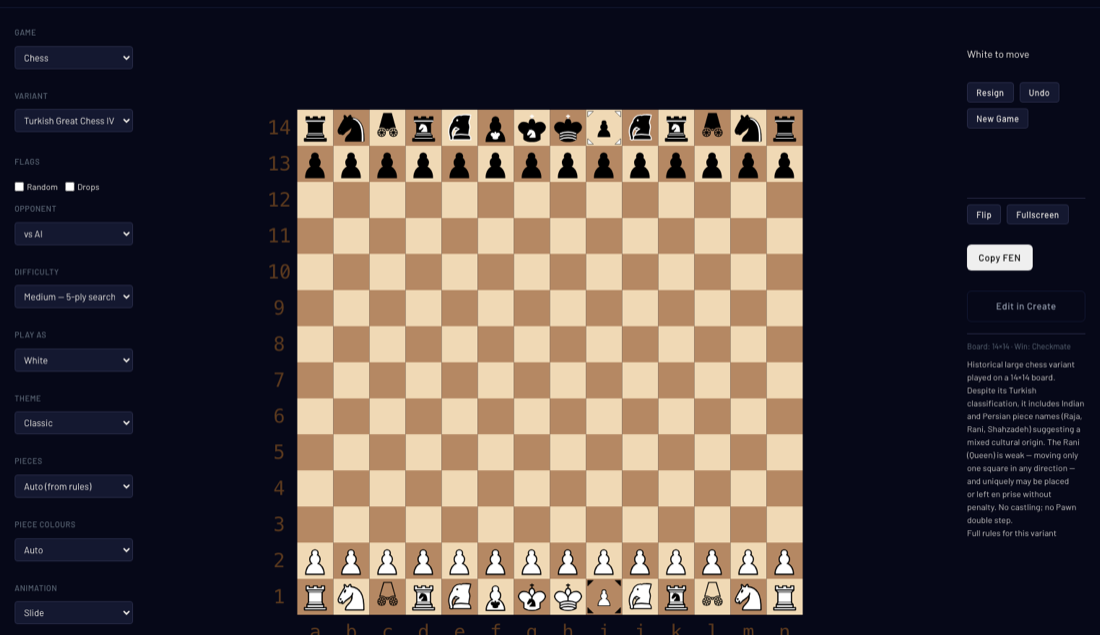
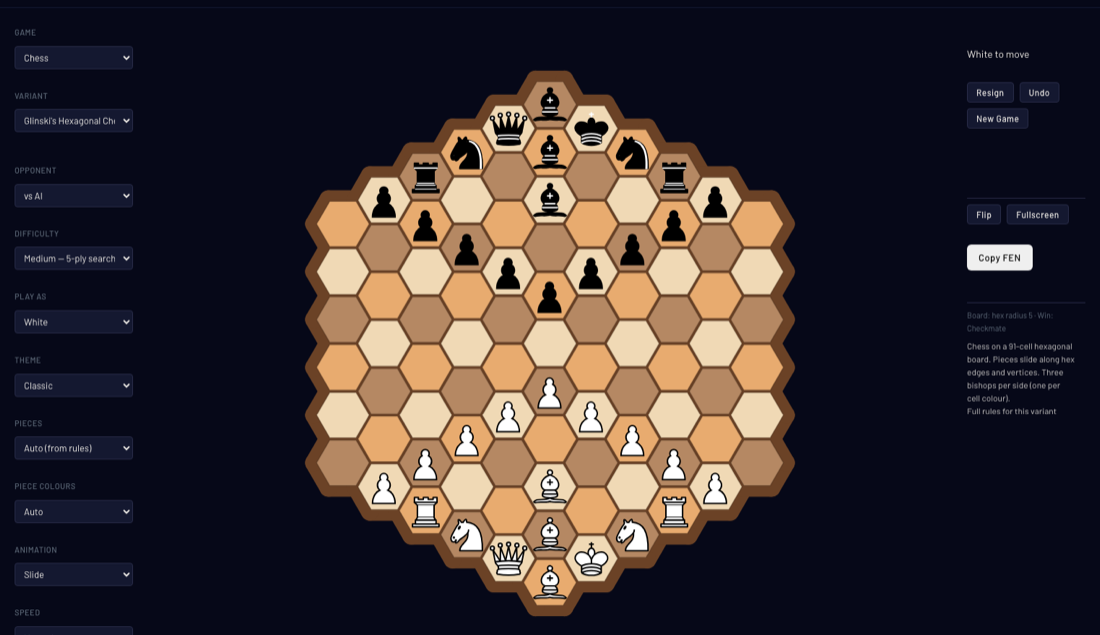
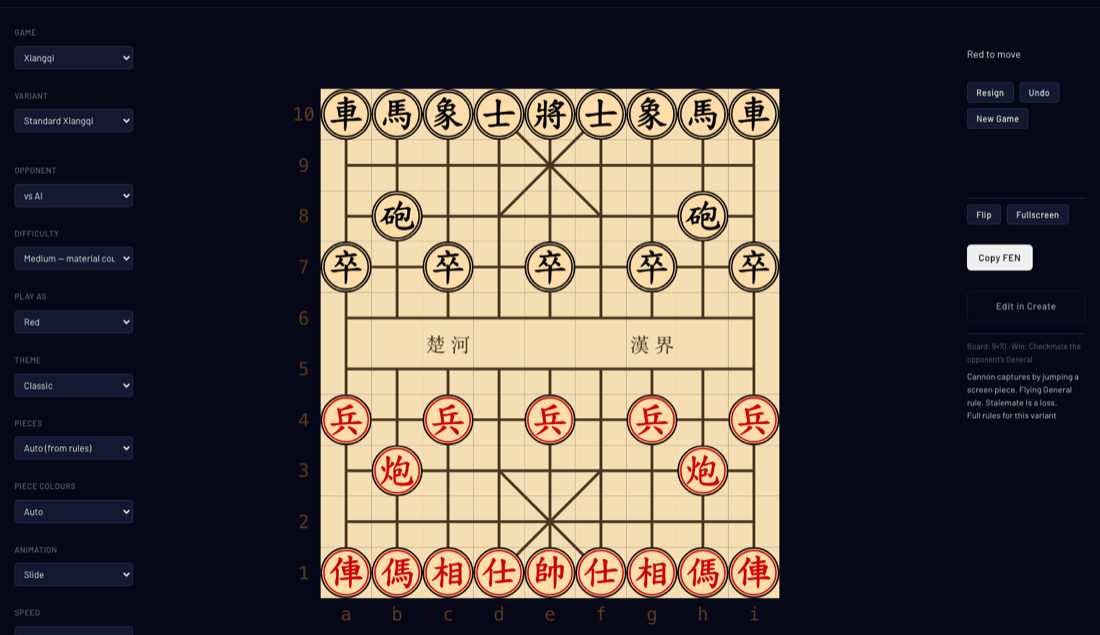
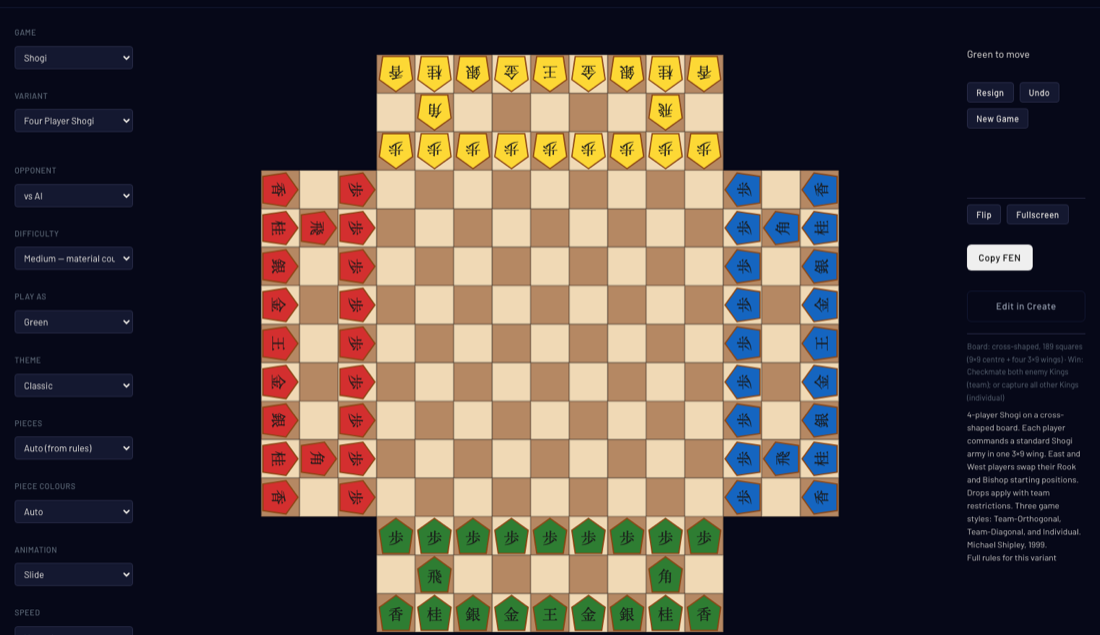
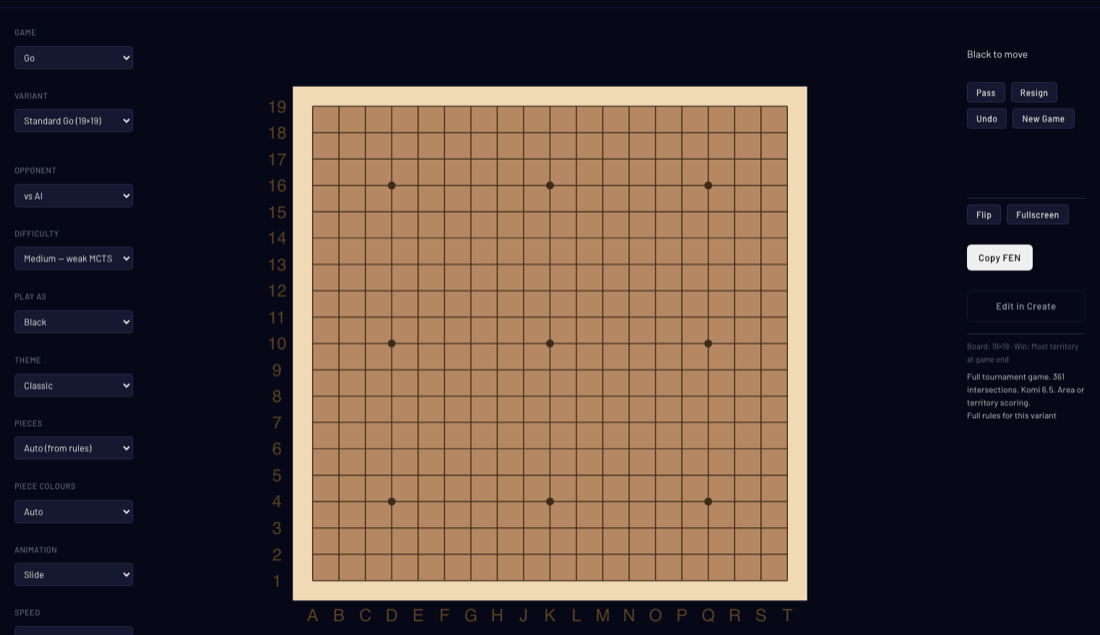
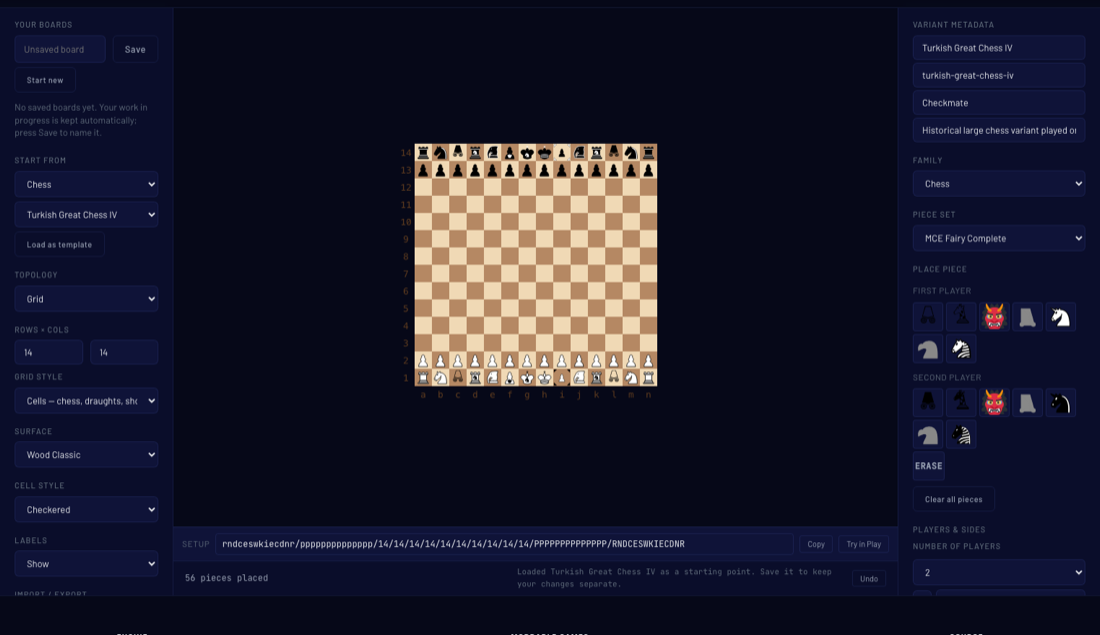
Every game from standard chess to Endless Skies runs from a config file. Plugins compose topology, pieces, and rules. Ship a game by writing YAML.
296 variants documented, 204 of them playable. When adding a game costs zero engineering, the catalogue compounds daily. AI agents write configs, not code.
One engine means one embed API, one SDK, one MCP server for every game. Third-party developers build once, reach every family.
No other tabletop platform offers AI-callable game engines. Ours are live, documented, and connecting to the fastest-growing developer ecosystem in history.
Universal play, rules search, piece gallery, RPG oracles, game utilities across 8 namespaces, all callable by any MCP-compatible agent.
MCP protocol, REST API, OpenAPI spec, llms.txt. Every integration pattern covered from day one.
Native ESM. Import our engines in browser, Node.js, or Cloudflare Workers — no bundler, no transpiler, no config.
Drop-in iframes for dice, decks, oracles, TI4, Nukes, and an API explorer. Auto-resize, themed to the host site, no build step.
Every AI agent that integrates our tools creates switching costs. Network effects compound with each new consumer.
No competing board game engine has MCP integration. We own this category before it has a name.
API usage becomes a revenue line as third-party agents build on our engines at scale.
AI agents research, write, and build games autonomously. The rulebook is the source of truth; engines consume it directly. A small team ships at the pace of a large one.
Agents scan patents, archives, and public domain sources. Verified content only.
Machine-readable markdown with frontmatter. Board topology, pieces, win conditions.
Config-driven board generation, movement primitives, and rule plugins bootstrap a playable game from schema. No hand-coding.
Website auto-generates play pages. Embed via iframe. Print-ready PDF rulebook.
Open-source rules invite PRs. Every variant is a pull request. Catalogue compounds.
The frontmatter file is a contract, not a skill requirement. Everything a variant needs is a handful of declarations, so the authoring step can be a form, a chat, or an agent writing on someone's behalf. The engine cannot tell the difference.
Describe the board, the pieces, and how you win. The fields are the game, and an agent can fill them in from a plain description.
Playable the moment it validates, with legal move enforcement and an AI opponent. No build, no download, no waiting on an engineer.
A link anyone can open, an iframe anyone can embed, and a print-ready PDF rulebook generated from the same file.
A mod is a file, so a marketplace listing is a file too. Designers keep the credit and the revenue; we handle hosting and fulfilment.
Licensed titles, implemented by their engineers. You cannot add a game, let alone a variant of one.
You can move pieces around, but nothing enforces the rules. There is no game to share, only a session someone has to referee.
Write the rules down and they become a playable game with an opponent, a board, an API, and a rulebook. That is the whole product.
Existing platforms digitise board games. We're building the infrastructure for people to create and sell them.
Digital-only. Closed ecosystem. No modding, no creation tools, no physical bridge.
Upload images, move them around. No rules enforcement, no AI, no print pipeline.
Fun but zero structure. No marketplace, no mobile, no web, no physical bridge.
Consumer SDKs, AI-orchestrated production, open-source rulebooks. 46 games shipped, 138 variants playable with AI. Embed anywhere.
Other games build on our engines. Dungeon Chess shipped on MCE — every new consumer deepens lock-in.
89 MCP tools live across 8 namespaces. Every AI agent that connects deepens network effects. No competitor has this.
Agents research, write, and ship games autonomously. $30K in compute has produced 46 games and 296 variants — $652 per game.
The only platform connecting digital play to physical production. BGA/TTS are screen-only.
A modder-founder, a systems-thinker playtester, a board-game evangelist who builds the engine, and a game artist with TV credits.

Modder since forever. Built the world's first NoSQL CMS and a 500 Startups-backed Bitcoin wallet.

Systems thinker. Chief playtester and social engineer leading online growth, marketing and manufacturing.

Web developer and board-game evangelist. Builds the online engine — grey hair earned the hard way.

Head of creative. BioHack and Mechamato — featured on BoardGameGeek and IMDB.